

.avif)
 Get a Mortgage in Principle online
Did you know a Mortgage in Principle can:

Show sellers you’re a serious buyer who knows their budget
Check your mortgage affordability with over 45 mortgage lenders
Get your certificate in minutes with our simple online form
What is a Mortgage in Principle?
A personalised certificate showing how much a bank or building society might lend you, based on your circumstances. It's not a guaranteed offer — it's the confident first step in your mortgage journey.
A Mortgage in Principle:
Helps you understand your budget
Shows estate agents you're a serious buyer
Can help speed up your property search
Is available online in minutes

Doesn't guarantee a mortgage offer
An L&C online Mortgage in Principle uses our triple filter
This triple filter looks at:

Lender's criteria - Will the lender accept your circumstances?

Affordability - How much could you borrow?

Product availability - Are the right mortgage deals for your circumstances available?
Your Mortgage in Principle certificate will show how much you can borrow. This will help you make sure the homes you're looking at are within your budget.
It's not a guarantee you'll get a mortgage, but it's the first step in your mortgage journey.
L&C Mortgage in Principle vs. High Street Lenders

| Key factors | L&C | High Street Lender (Bank) |
|---|---|---|
| Deals checked | Checks 45+ lenders and thousands of deals | Only checks their own internal products |
| Best for | Checking criteria from across the market | Customers who want to use a specific lender |
| Credit impact | Criteria check with no credit search | Best for simpler cases (steady PAYE salary, clean credit), assessed case by case — you'll need to meet their specific criteria |
| Complexity | Great for self-employed, customers with unique income, standard PAYE employees and everyone in between | Usually a soft search for the DIP, but some may use hard searches |
| Exclusive deals | Access to 'broker only' rates not found on the high street | May offer 'loyalty rates' or fee waivers to current account holders |
| Reliability | Verification that multiple lenders should accept you | Confirmation that this specific bank will likely lend to you |
| Application help | Dedicated adviser and case manager handle all paperwork and chasing | You manage the application and documents yourself |
| Cost | Free | Free |
We'll help you throughout the mortgage process — no hidden costs or surprises, just straightforward, honest mortgage advice.
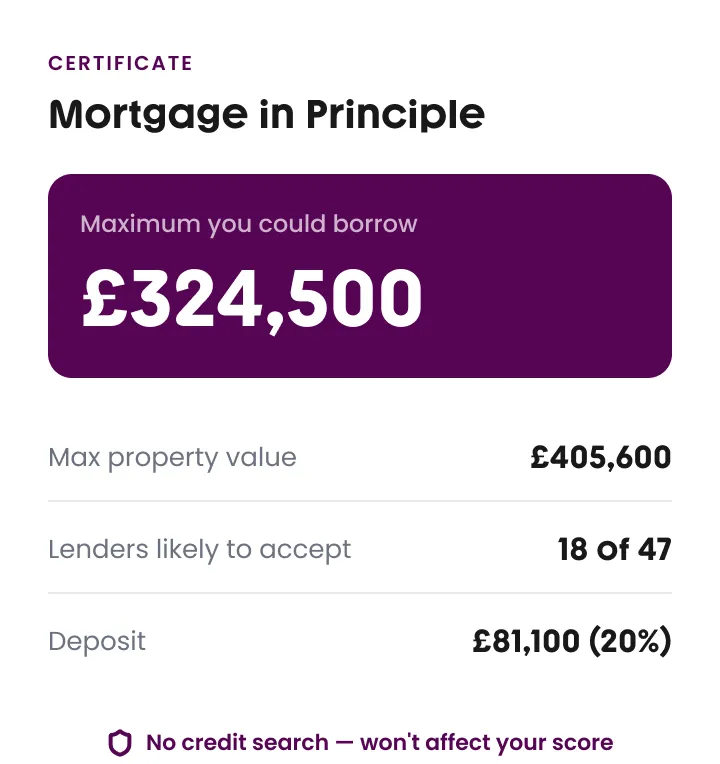
What the L&C Mortgage in Principle certificate shows
When you get your Mortgage in Principle you'll see:
Maximum borrowing amount
Maximum property value
Mortgage in Principle certificate
Lenders likely to accept you
Mortgage deals you may qualify for
A clearer idea of your next steps


How to get a Mortgage in Principle
To get an L&C Mortgage in Principle you'll need to provide some basic details about your finances, such as your income, outgoings and any debts.
Getting an L&C Mortgage in Principle doesn't mean you have to apply for a mortgage. But if you want to know how much you could borrow, a Mortgage in Principle is the place to start.
We check over 45 lenders. A bank only checks itself.
A Mortgage in Principle direct from a bank only ever shows what that bank would lend. We check affordability across the whole market — then run our triple-filter criteria check on top.
It doesn't guarantee you'll get a mortgage — but it shows which deals you're likely to qualify for, and saves you time when you're ready to apply.
What do you need to apply for a Mortgage in Principle?
There’s certain information we need to know to get you your Mortgage in Principle certificate. This includes:
The type of mortgage you’re looking for and your deposit
Your personal details including name, date of birth and contact details of applicants
Your income details such as salary and any bonuses
Your out goings and any debt, including student loan
Details about the new home you are looking for or planning to buy

Ready to start?
Get your free Mortgage in Principle certificate — no credit check, no commitment, usually ready in 20 minutes.
Mortgage in Principle for first-time buyers
A Mortgage in Principle (also known as an Agreement in Principle) shows how much you might be able to borrow. While it's not a guaranteed mortgage offer, it can show sellers and estate agents you're a serious buyer.
Why do estate agents ask for one?
Estate agents might ask if you’ve got a Mortgage in Principle before arranging viewings or accepting an offer. It helps show you've already had an affordability check and are in a position to proceed if you find the right property. This can make your offer more attractive to sellers.
How much deposit will you need?
As a first-time buyer, you'll typically need a deposit of at least 5% of the property's value, although a larger deposit could give you access to better mortgage rates and a wider choice of lenders. The exact amount you'll need depends on the property price, your circumstances, and the lender's criteria.
When to apply
It's usually a good idea to get a Mortgage in Principle before you start house hunting. Knowing how much you can borrow can help you set a realistic budget and focus on properties within your price range.
What happens next?
Once you've found a property and your offer’s been accepted, you'll make a full mortgage application. Your chosen lender will carry out more detailed affordability checks, review your documents, conduct a credit check, and arrange a valuation of the property before making a formal mortgage offer. If everything is approved, you can move on to the legal process and work towards exchanging contracts and completing your purchase.

FAQs
Without one, you have no idea how much you can borrow. That makes viewing properties tricky because the homeowner and estate agent usually prefer buyers in a position to proceed.
From their point of view, they could have ten people view the house but five of them might not be able to even buy the property, which is a waste of time for all involved.
However, by taking that first step and having an indication of how much you can afford, and which lender is likely to approve you, the seller and estate agent have confidence in your ability to buy and may even favour you over people without a Mortgage in Principle.
Once you’ve found a property, you can begin a formal mortgage application. Your lender will want a valuation to be carried out on the property before they’ll issue a formal mortgage offer.
There are three levels of valuation, usually performed by a surveyor who's a member of the Royal Institution of Chartered Surveyors. These vary from a basic report to confirm the value of the property through to a full building survey.
Your lender will also complete any final checks on your circumstances, including your credit history and the source and reliability of your income and outgoings.
If your application is successful, you'll receive a formal mortgage offer — official confirmation from the lender that they'll provide a mortgage to you.
There area few different ways people refer to a Mortgage in Principle. You might have heard it called a:
- Decision in principle (DIP)
- Mortgage in principle (MIP)
- Mortgage agreement in principle (MIP)
- Mortgage promise
- Agreement in principle (AIP)
Estate agents, building societies, banks and brokers might call them different names, but they all mean the same thing.
Usually no. Many UK lenders use a soft credit check for a Mortgage in Principle (which doesn't affect your credit score).
However, asmall number of lenders use a hard credit check, which leaves a visible footprint on your credit file and may cause a slight temporary dip in your score.
L&C won’t conduct a credit check when you apply for our Mortgage in Principle, so it won’t affect your credit score at all.
A soft search is a background check that does not affect your credit score. A hard search is a full application check that can affect your score and is visible to lenders.
Simply, a Mortgage in Principle just means you’ve got proof lenders might be willing to lend you a certain amount to buy your home.
It also shows sellers you’re serious and helps you budget before you start house hunting.
Whilst a Mortgage in Principle isn’t a mortgage offer, it’s the first step in the mortgage process.
Once you fill out our simple online form, we can email you your Mortgage in Principle certificate within 20 minutes. Sometimes it can take a little longer, but you’ll generally have a Mortgage in Principle certificate within a day of applying.
A Mortgage in Principle from a lender usually lasts between 30 and 90 days because it's credit scored. Your L&C Mortgage in Principle isn't credit scored, so it doesn't have a use-by date.
However, if your circumstances change, or the lenders’ affordability criteria change, then it’s best to revisit your Mortgage in Principle to make sure you’ve got the most up-to-date certificate. However, it’s best to apply for a Mortgage in Principle before you’ve started looking for properties because it can help you understand your borrowing limits. If your circumstances have changed, you can apply for a new one.
Getting a Mortgage in Principle couldn’t be easier. Simply go online and get your certificate today.